The basics of laser cutting that you must master (1)
As early as the 1970s, lasers were first used for cutting. In modern industrial production, laser cutting is more widely used in sheet metal, plastics, glass, ceramics, semiconductors , textiles, wood, paper and other material processing.
In the next few years, the application of laser cutting in precision machining and micromachining will also achieve substantial growth.
Laser Cutting
When the focused laser beam hits the work-piece, the irradiated area heats up rapidly to melt or vaporize the material. Once the laser beam penetrates the work-piece, the cutting process begins: the laser beam moves along the contour while melting the material. A jet of air is usually used to blow the melt away from the cut, leaving a narrow gap between the cut part and the plate frame, which is almost as wide as the focused laser beam.
Flame cutting
Flame cutting is a standard process for cutting mild steel, using oxygen as the cutting gas . The oxygen is pressurized to up to 6 bar and blown into the cut. There, the heated metal reacts with the oxygen: combustion and oxidation begin. The chemical reaction releases a large amount of energy (up to five times the energy of the laser) which assists the laser beam in cutting.
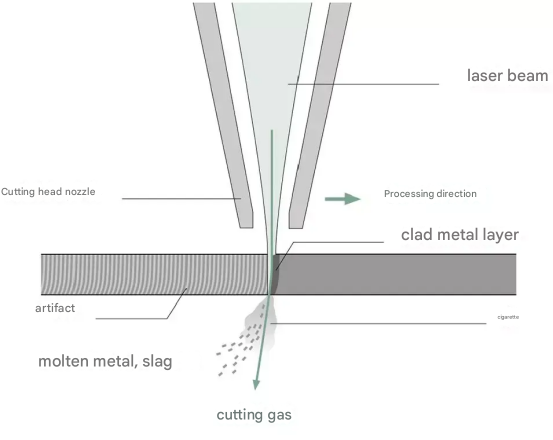
Fusion cutting is another standard process used when cutting metals. It can also be used to cut other fusible materials such as ceramics.Nitrogen or argon is used as cutting gas, and the gas with a pressure of 2-20 bar is blown through the incision. Argon and nitrogen are inert gases, which means that they do not react with the molten metal in the incision, but only blow them to the bottom. At the same time, the inert gas can protect the cutting edge from being oxidized by the air.
Compressed air cutting
Compressed air can also be used to cut thin plates. Air pressurized to 5-6 bar is enough to blow away the molten metal in the cut. Since nearly 80% of the air is nitrogen, compressed air cutting is basically melt cutting.
Plasma assisted cutting
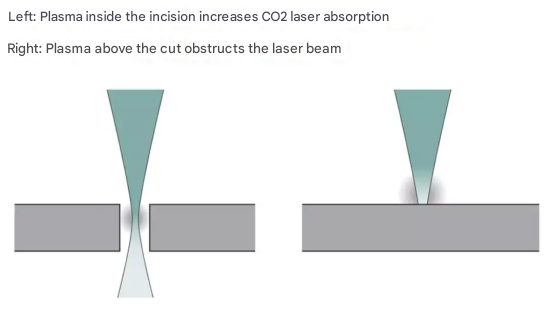
If the parameters are properly selected, a plasma cloud will appear in the cut of plasma-assisted melting cutting. The plasma cloud is composed of ionized metal vapor and ionized cutting gas. The plasma cloud absorbs the energy of the CO2 laser and converts it into the work-piece, so that more energy is coupled to the work-piece, the material will melt faster, and the cutting speed will be faster. Therefore, this cutting process is also called high-speed plasma cutting .
Gasification cutting
Gasification cutting evaporates the material, minimizing the thermal effects on surrounding materials. This effect can be achieved by using continuous CO2 laser processing to evaporate low-heat, high-absorption materials, such as thin plastic films and non-melting materials such as wood, paper, and foam.
Ultrashort laser pulses allow this technology to be applied to other materials. The free electrons in the metal absorb the laser and heat up dramatically. The laser pulse does not react with the molten particles and plasma, and the material sublimates directly without time to transfer energy to the surrounding material in the form of heat. There is no obvious thermal effect when picosecond pulses ablate the material , and there is no melting or burr formation.
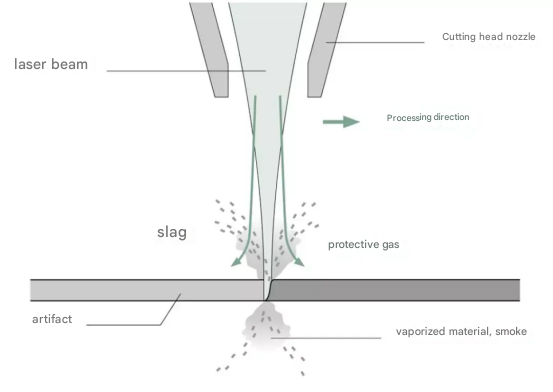
Figure 3 Gasification cutting: The laser vaporizes and burns the material. The pressure of the vapor causes the slag to be discharged from the cut.
Parameters: Adjusting the machining process
Many parameters influence the laser cutting process, some of which depend on the technical performance of the laser and the machine tool, while others vary.Degree of Polarization
The degree of polarization indicates what percentage of the laser light is converted. A typical degree of polarization is around 90%. This is more than enough for high-quality cutting.Focus diameter
